M.


Conquest
Product Design
What is Conquest
Conquest is a board game used to facilitate a 4 member group discussion. It ensures that there is a balanced participation from all members of the group. It was also selected as one of the top Exploring Interaction project of the year.
-
Key Goal
Conquest was a student project done for my masters at TUDelft for the course
Exploring Interactions. The course was through an entire semester and main idea was to understand the concept of interaction and how we can influence or change it through design.
-
My Roles + Responsibilities
I did user research and analysis and physical prototyping and testing in the context.
-
Timeline & Team
Projected was completed in 5 months and was an individual project.
-
Tools
Prototyping, Lasercutting, Illustrator, Premier Pro, After Effects
-
Year
2019-20.
Problem Statement
The context I picked for the course was 'group discussions'. A Group Discussion is a really dynamic context with multiple people involved. Most importantly, there are several different interactions happening, diverse bunch of people both in terms of personality and behavior and interesting inter personal interactions.

Context
Group discussions with 4-5 participants that work together towards a common goal.
eg. a brainstorming session.
Introverted participants feel...
• It’s hard to speak up when others are talking
• Unsure when to speak up
• Others may not listen to them
• Left alone/disconnected from the group

Users & Audience
To understand the context, the interactions and the various people involved, I performed
different user research activities like survey, observational studies, generative sessions


Design Goal and Interaction Vision
A design goal was established to create a focus for the kind of interaction and users I wanted to influence with my design. The Interaction Vision was used as a method to guide the characteristics of the design direction.
Design Goal

Help introverted speakers who want to actively participate to participate more easily in a group discussion.
Interaction Vision

I want my user to feel like a musician playing his/her
instrument in an orchestra.
Characteristics :
Confident , Important, Immersed, Comfortable
Prototyping
In order to evaluate my tests, I decided to consider three factors which I graded to each of my prototypes based on observation and feedback. This was to be able to reflect on whether I was exploring in the right direction.
Turn taking : To understand if there is a clear or established order in who speaks when during a group discussion
Engaging : Does the design evoke a prolonged interest in the participants
Motivation : Are partcipants motivated to participate and do they experience positive emotions?
Prototyping Phase 1

Test 1
Card game
The idea was to create a fun engaging game that could motivate participation from everyone. It had various interactions to motivate speakers and stop speakers : the wait, stop and like cards. There were some rules to the game that the participants had to follow in order to facilitate turn taking. Participants had to finish all turn cards to win.


Test 2
Slide
I wanted to test the idea of queuing. I assumed having balls (different object from cards) would be a fun way of taking turns. Each participant was given a colored ball and asked to use to mark their turn and those who want to speak next should put in their ball and wait for their turn.


Test 3
Lights
I wanted to test lights as a means to communicate visual cues. It was a simple circuit of a light and button. The speaker should press the button to indicate his/her turn.
It was made of Arduino with simple push buttons and different colored LED lights.


Test 4
Flippy Cards
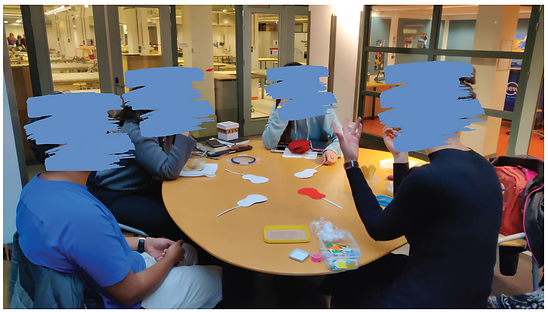
The lights had an issue of being too small. I wanted to test if bigger visual cues helps better. The same idea of lights but here used an ambiguous shaped card to flip when each person wants to talk.


Test 5
Card Game - modified
I wanted to retest the card game with some additional elements - question cards and giving only one turn card. Here, the speakers were given a point if they used a question card to help an introverted speaker to speak up.


Evaluation
On evaluation, it was interesting to find the different elements or factors that worked and the others that din’t. Evaluating it on the three basic factors ie. turn taking, motivation and engagement allowed me to understand what user expectations were. In the end, I realised a game that mandates the equal participation from every participant and with inter - personal interactive elements to increase motivation would be a good solution for the problem space.
Concept Direction
Collective Winning
I decided to employ the concept of collective winning. In collective winning, every player is expected to co-operate with one another to achieve similar goals. Here, no one person can dominate entirely and at the same time a player cannot avoid contributing. Every person is expected to play their individual roles in a fair manner in order to win.
Exploring board games
I explored various games and tried to understand their dynamics in order to find inspiration for my final concept. A lot of them were strategic board games that involved collective decision making/thinking.

Challenge
A very challenging aspect of creating a game for a group discussion was trying to make the concept as simple as possible. The game should not be a distracting element, it should rather facilitate a healthy discussion with the primary focus being the topic of the group discussion itself.
Prototyping Phase 2

Test 6
Defend your city
In this game the goal is to defend your city by building a wall together. Each person has to place their coin at the pink field to indicate their turn. If they finish 4 turns, they were rewarded a brick or a piece of the wall.


Test 7
Conquering islands
In this game the goal is to conquer small islands together as a team. Each person has to place their coin at the pink field to indicate their turn. If they finish 3 turns, they were rewarded a pole/flag to conquer their part of the island. A player can’t proceed to the next island until everyone conquers the previous isalnd.


Evaluation
Two evaluation forms were given to the participants before introducing the product and after introducing the product.
In the first form, the participants were asked to answer based on their general experience of group discussions. Following that the prototype was tested and the second evaluation form was given to the participants
No of participants : 16
Graph 1 : The following graph shows the rating given by introverted participants. Level of introvertedness was based on how the user scored themselves between the range of 6-10 on the scale in Question 1 : Level of introvertedness.

Graph 2 : The following graph shows the rating given by introvereted partcipants before the game was tested. Level of introvertedness was based on how the user scored themselves between the range of 6-10 on the scale in Question 1 : Level of introvertedness.

Graph 3 : The following graph shows the rating given by extroverted participants/confident speakers. Level of introvertedness was based on how the user scored themselves between the range of 1-5 on the scale in Question 1 : Level of introvertedness.

The game was well received by the introverted participants as it favored their behavioral needs. i.e turn taking, reduced interruption and ease of joining the conversation as seen in Graph 1.
However, the more confident speakers din’t prefer the game as much, as evident from the ratings (Graph 3) because they don’t really need the game. Howver , listening was considered to be lesser as the game was a bit distracting.
Factors that were positively received by both groups of users was turn taking, reduced interruption, awkwardness of knowing when to talk, engagement of the game and if the game was played with strangers.
In conclusion, the game helps introverts but extroverts may feel stifled by the game as it controls their tendency to talk too much.
Positive Results

Not so positive results

Final Prototype
The Conquest is game that acts as a tool to help facilitate group discussions. It helps introverted speakers to easily join a conversation by visually communicating to the group that they want to talk. In the game, each speaker has to speak three times (in no specific order) to conquer a small part of the island. Subsequently, all the participants have to finish their own three turns for the entire island to be conquered. Even if one member can’t, everyone loses a point. This creates a need for collective winning where one person cannot entirely dominate or cannot entirely be left behind.


Reflections
This was my first individual project at TUDelft and there was a huge learning curve but as a student, I thoroughly enjoyed the entire process.
-
I am delighted that I picked up many skills along the way during the course.In several instances, the course pushed me to go beyond my comfort zones and my familiar skill sets.
-
For instance, most of my design work has been digital. I had never worked with physical prototypes or tested them in contexts. Also, making a video at the end pushed me to explore basic video editing skills and learn Adobe After Effects and Adobe Premier Pro.
-
Additionally, it also helped me to learn project management and planning as the course provided the freedom to create my own goals and schedules to progress through the project.